Thursday, August 23, 2012

Armenia - Sardarapat Monument

After St. Echmiadzin tour, we headed out to the Sardarapat Monument, which marks the battle of Sardarapat, Armenia's most significant military victory in 1918 against Turkish forces, without which current Armenian land would most likely not exist.


The stone statues of two massive winged lions flank a bell tower.  (The Stone Garden Guide - Armenia & Karabagh)

When we arrived at the monument, we saw a group of young Armenian dancers, who we later found out are there from Argentina.  I think they were preparing for a video, and they were not so thrilled when we were in their way.  However, they did humor us for a couple of photos.


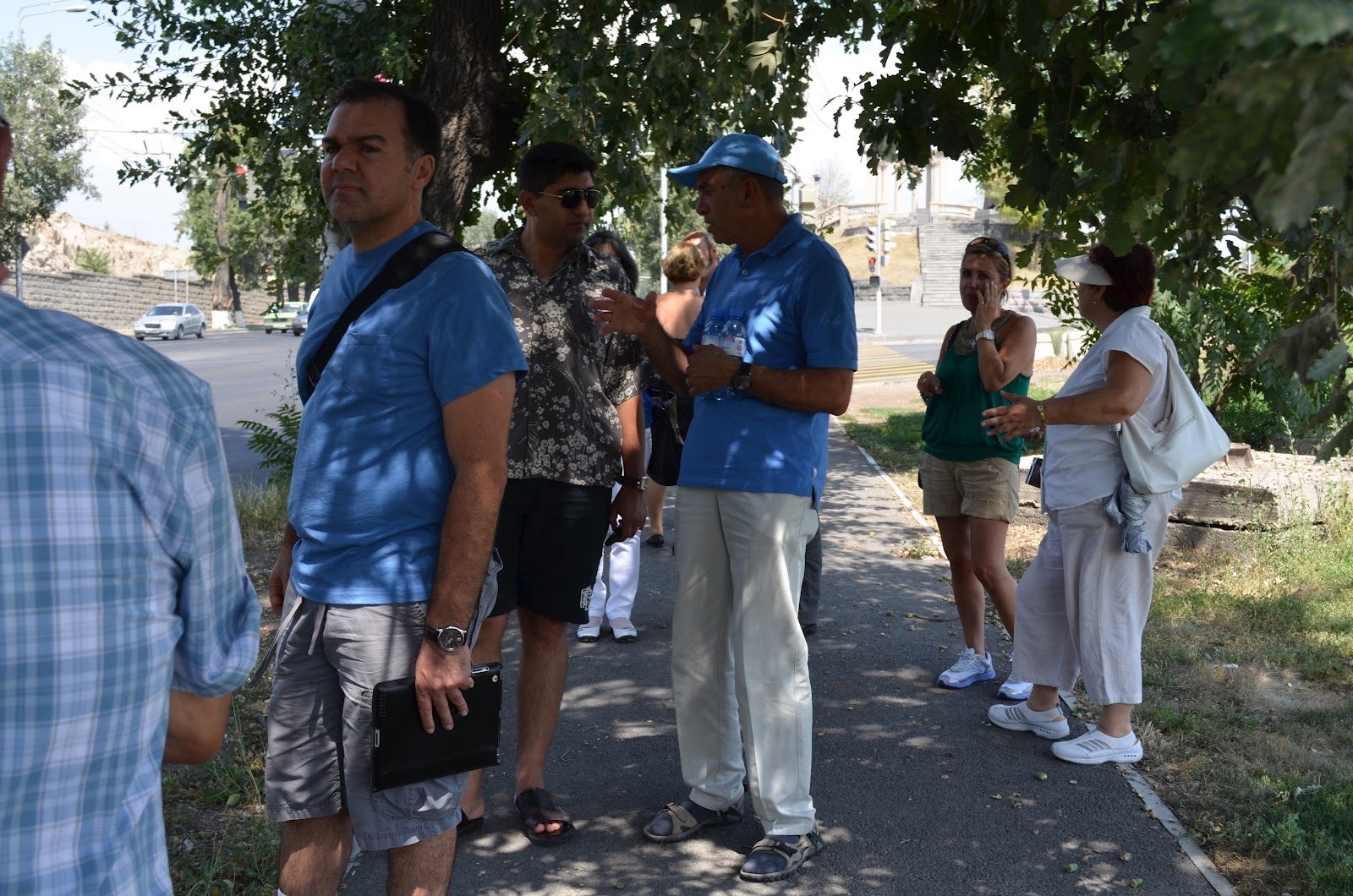
After we left Sardarapat, the plan was to go to the Genocide Memorial, however, right near the U.S. Embassy in Yerevan, our bus broke down.  We were stranded for about an hour on the side of the road, waiting for another bus, which never made it.  We ended up taking multiple taxis and went directly to a late lunch at a German restaurant (which was delicious!) and ended our day early.


Wednesday, August 22, 2012

Armenia - St. Echmiadzin Cathedral

On the third day of the tour, our first stop was St. Echmiadzin Cathedral, the holiest religious site in Armenia.  I've heard about it for so long, I was excited to finally see it in person.  I was surprised to find the main cathedral and two other churches in a very large complex, with beautiful gardens.


I went inside to light some candles for all my members of family said a quick prayer.  Although I've refrained from drinking the water from fountains, this is the only place where where I took a sip.


I also took the opportunity in this wonderful setting to practice taking some photos however, the time of day wasn't so right for the light.


I wish we had more time there to set around and really take in this beautiful church and it's surroundings...

Monday, August 20, 2012

Armenia - Sevanavank Monastery and Lake Sevan


For dinner, we headed out towards Lake Sevan.  I was excited to see the lake in hopes of maybe putting my feet in the water.  When we got there, we had about an hour or so of free time to do souvenir shopping and walking up to the Sevanavank monastery before dinner.  The weather at the lake was much cooler than Yerevan.


I immediately headed up the steep steps to the monastery for some fabulous views of the church and the lake.  On the way, the local vendors were selling sunflowers with seeds and corn.  This car is a very commonly seen car all over Armenia.  Though they're old, they're still functional.


I went inside the church for a quick look and prayer, and found the priest there scolding people (rightly so) for the way they were dressed coming into the church.  He threw out a young girl for having worn short-shorts and midriff bearing shirt, and told another girl to take her sunglasses off the top of her head, because it's no way to come into a church.  I was really nervous he was going to pick on me for something, but he didn't.  I quickly said my prayer and exited.


The church is surrounded by many khachkars, stones with cross carvings on them.  The Armenian cross is very special and different from other crosses.  It's based on the tree of life concept, always floral, with each arm having three leaves, symbolizing the Holy Trinity.


The view of the lake from the monastery is just wonderful.  One can sit there and look down for hours.  There used to be many fish in the lake, however, during the hard times in Armenia, there was much over-fishing and there's no more of the local white fish.  Fishing is currently not allowed there until the fish population recovers to a healthy level.


Before dinner, I did some souvenir shopping but wasn't able to find much of the things I was specifically looking for.  Thinking back, it was probably the best spot to get more souvenirs, but oh well...  When time is limited, and there's so much to see and take pictures of, spending much time looking at things to buy seems like a waste-time.


And I walked down to the lake, but did not put my feet in.


Sunday, August 19, 2012

Armenia - Tavush Region and Haghartsin Monastery

I was pretty exhausted after the first day of the tour.  But every morning we started on the road around 9AM and finished by 5:30-8:00PM.  So each day was quite tiring.

We started the second day by visiting the Armenia Fund projects...  the water irrigation system, the secondary school, and the agricultural projects.  The most interesting one was the fact that they brought 100 Belgian and Dutch cows to Armenia.  These cows, unlike the local cows, produce 10 times more milk so they were especially brought in to help the local farmers and the local produce.  These cows were so pretty in comparison to the local Armenian cows...


Belgian and Dutch cows

v.

Armenian cows


After visiting with the cows, we headed out to Haghartsin Monastery in Dilijan.  The churches in the complex date back between 10th and 13th centuries.


Haghartsin Monastery is one of the few functioning monasteries in Armenia.  Baron Khosrov grabbed the first monk there and started telling his stories.  By this time, the people in our tour had stopped listening to him so he would talk to the first person he would see at each stop.

Armenia - Yerevan city highlights

At the end of the first day of touring in Yerevan, my friend Silva, who was also in Yerevan for vacation, met up with me and we spent a few hours walking around and discovering (for me) and re-discovering (for her) the city.  Armenia has been independent from USSR only since 1991 and is still a developing country.  I was told my many that even if you visit Yerevan every year, you will see many many changes.

Yerevan is a lovely city, alive with people out and about each day and each night, reminding one of the real meaning of having a social life.  The Republic square is chirping with young people, and families ranging from grandparents to little children.  The main attraction at night seems to be the water fountain show in the middle of the square.  Every night has a different theme.  One night the show had just songs about Yerevan.  Another night, it was French songs.  Another night it was classical music.  People gather and watch and cool down from the August heat from the day.


The parks and squares have statues of many Armenian intellectuals, writers, composers, architects, from Komitas to William Saroyan.  There are so many places to visit within Yerevan.  On another day with Digin Karine and Dr. Vahe we spent an hour at the Cafesjian Center for the Arts within the Cascade complex.  The Cascade has many fountains and different types of sculptures by different artists.  One of the most interesting ones to me is Lion 2, (2008), by Korean artist Ji Yong-Ho.


Mother Armenia Statue can be seen from many parts of Yerevan.  It originally was a statue of Stalin, but after he fell out of favor, it was modified and replaced by Mother Armenia and resides in Victory Park.  There is a museum located at the base of the monument.


People-watching is one of my favorite pastimes in Yerevan.  I must say, the people dress pretty differently than what I'm used to.  For women, big hair, short, tight and low-cut dresses seem to be the style.  For men, the styles are all over the map...  This guy may have been channeling a young Al Pacino...

Armenia - Geghard Monastery & Matenadaran Museum

Geghard Monastery was our 2nd stop after Garni Temple.  It's a representation of Armenian Medieval architecture, remaining building dating back to the 13th century, carved into the side of the mountain.
It no longer functions as a monastery, but has a functioning church.  Geghard is the Armenian name for "spear" representing one of the spears associated with the crucifixion of Jesus.  Here again I had to take photos with my phone, so the images do not justify the beauty of the location.

After Geghard Monastery, we went to Matenadaran Ancient Manuscript Museum.  This is when we all realized that we had two tour guides.  Suzi, the official tour guide, and Baron Khosrov, the unofficial tour guide.  He's originally from Armenia but now lives in L.A.  He's 75 years old, and he has lots and lots of stories about each site we've visited and is not shy about telling these stories to fill in the blanks.  He has incredible memory.  He's the main most interesting character in the tour, with his knowledge and interest, and energy level.


The manuscript museum was so interesting for me.  There were so many manuscripts and bibles from the 5th century, handwritten in Armenian.  The history on the development of our language and how the manuscripts were created, from the smallest (about 2 inches) to the largest ones (an arms length or so) was incredible to see.  Unfortunately I wasn't able to take any photos inside.  The below photo is taken outside the museum with Mesrop Mashdotz, the creator of the Armenian alphabet.


Armenia - Garni Roman Temple

I arrived in Yerevan on the evening of August 7th...  I met up with the Armenia Fund Director Sarkis at the airport and all the Armenia Fund tour members took the bus to Congress Hotel near the center of Yerevan.


In the morning, August 8th, I met some of the tour group members after breakfast:  Karine, Emma, Manya & Vigen, Tamar & Nerses, Araks & Vahe, Janet & Mike (Mantzig), Baron Dr. Vahe, Baron Khosrov...  Then there were people who worked for Armenia Fund:  Sarkis, Ludwig, Sarko (video producer), Tigran (cameraman), and Digran (driver).

Of course in my excitement I forgot to put the battery in my camera so the first day I had to use my phone to take photos.  Our first stop on the tour was Garni Roman Temple, which is the only remaining temple in all of Armenia.  It was built in the 1st century AD, dedicated to a sun god, with 12 columns representing the hours in the day.  When Armenians became Christians in 301AD (first country to accept Christianity), all the temples were ordered to be destroyed by King Trdat III, but Garni temple remained and was restored after the 17th century earthquake destruction (restored in 1975).


There is also a bath-house in the Garni complex, which shows different quarters designed for different temperature levels, with stone mosaics.


During our tour of Garni, there was a group of tourists from Israel.  One of the tourists, an older man named Gabriel, started talking to me.  Granted, majority of the people visiting Armenia from other countries are older people...  They were touring Armenia and Georgia.  He kept following me around the temple complex, wanting to know more about me.  But he was sweet and took a photo with me and we parted ways...